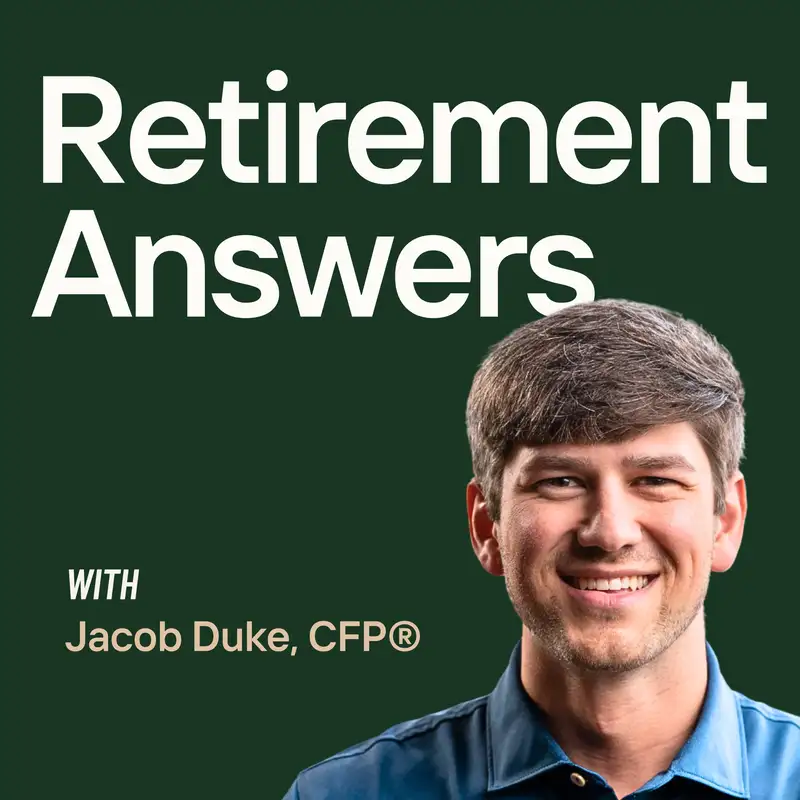
The Secret Ingredient to a Successful Retirement
So, what do we think the missing ingredient is? I would say that it's flexibility. Meaning, we have to have the opportunity to have options be flexible in our retirement plan. And this is going to crop up in two different ways. Welcome to Retirement Answers, a podcast built to answer your most pressing retirement questions.
Jacob:If you're someone who's either thinking about retirement or already in retirement, well, you're in the right place. Hey there. My name is Jacob Duke, and each week, I'll be walking through different tips and strategies to help you succeed in retirement. So let's go ahead and get started with today's show. Hey friends, and welcome back to another episode of Retirement Answers.
Jacob:My name is Jacob Duke, as always. In this episode, we're gonna be walking through what I think might be the missing or the secret ingredient to a successful retirement. This is gonna be something that I see most people overlook or don't pay attention to. In fact, they kind of disregard it. And so we're gonna talk through that, but before we do, I wanted to highlight this week's listener review, and it comes in from Sean, and he gives the show five stars and says, practical information.
Jacob:Jacob is a great teacher and I listen regularly. Well, Sean, thank you so much for that review. It means a lot to hear that it has been an impactful and positive podcast for you. If you're like Sean and wanna give some feedback, please do. You can do that on Apple Podcasts where you can leave a written review.
Jacob:All right, let's go ahead and jump into what I think the secret ingredient is to a successful retirement. Okay, so what do we think the missing ingredient is? I would say that it's flexibility, Meaning we have to have the opportunity to have options or be flexible in our retirement plan. And this is gonna crop up in two different ways. The first being most people are trying to be exactly right about all things retirement.
Jacob:They're trying to plan it out exactly how they think it's gonna go based on estimated or average returns they should get, or when's the perfect time to file for social security, and what's the best option, Medicare Advantage or Medigap or Medicare Supplement, all these different options. There's so many things to know and many people wanna be exactly right. And that's easy to understand, right? We're trying to do something we've never done before. It's very scary to leave a career or a job and have to make all these decisions that really impact you moving forward through the rest of your life.
Jacob:And some of these decisions are not reversible. So we're trying to make sure that our Monte Carlo simulation is a 100%. We're trying to make sure we have the exact spending amount we think we're gonna spend for the rest of our lives. All these different factors and things, we're trying to do them exactly right. So that's the first thing that a lot of people miss or mess up.
Jacob:They're trying to be exactly right before they take action and actually go into retirement. The second thing is they don't really have flexibility in their plan. Meaning they're trying to max out how much they can draw from their portfolio every single month or every single year. They don't have any wiggle room there. They they have to take their social security at 62, which means they're cutting back on how much their benefit is, but they're starting it sooner.
Jacob:All of their money might be tax deferred, which means they have a tax liability that sits there and waits for them moving forward throughout the rest of their life. And finally, maybe not having any cash or any after tax assets to live on or draw from could be a huge issue moving forward. So those are some things that lead to no flexibility within your plan, meaning you have to do something rather than getting to do something. So those are the two different areas of flexibility that I wanted to talk through today and go through that and see what some of the issues with those are and maybe why these things are holding you back from a successful retirement. So the first one going back to having to be exactly right on everything, having a Monte Carlo leading to 100 chance of success, all these different things we're trying to plan it out exactly right.
Jacob:The hard part there is it often leads many to analysis paralysis. In fact, I get a lot of calls, emails, and people reaching out saying, Jacob, can you review my plan? Can you make sure that I'm on track? Can you do all these things? And those things are helpful, and I like to do that with people if they're wanting to work with me as a client ongoing.
Jacob:But the hard part is, is there's no way to know exactly what's gonna happen. And it would be foolish of me to say that yes, you are gonna be successful in retirement if you follow this plan, because in fact, the plan is gonna change. So we often have this analysis paralysis that it kind of pops in and really holds people back from retiring whenever they can. So they're trying to get it all dialed in exactly right and make sure there's no rock unturned. And that's fair.
Jacob:We want to be able to do that. We want to make sure we're covering the major risks that could come up in retirement. But I find that a lot of people end up never retiring or end up retiring way too late because of this analysis paralysis and having to be exactly right every step of the way. The second part of this is, well, it leads to frustration, right? Because, we're trying to get the exact map, the exact route to get where we're trying to go.
Jacob:And oftentimes it's not exact. There's many answers that lead to the same place. And so, I like to say, hey, there's really not a right answer here. It's more of a preference. Which one do you want to do?
Jacob:And we have to understand there's pros and cons of going one way or another. So here's maybe an example of how I like to explain this. Let's say you're lost in the wilderness and you know that the river that can lead you out of it is West, and you know which way is West. So you turn and you go West and you start walking, right? If you just keep walking west, you will know that you will hit that river and you will be able to find a way out of the wilderness, right?
Jacob:The thing there that we need to know is you know the general direction that you're going, right? You don't have to know the exact steps or the exact path and to be fair, there maybe are easier ways to go or harder ways to go, you don't really know what those things are. But if you know the general direction you have to head to find safety, you will take that general direction. So the idea is not so much we have to know the exact trail or the exact path we're gonna take to get out of this wilderness. All we know is we need to head in this direction.
Jacob:If we keep going, we will get there. So think of it that way. If you're trying to have a wonderful retirement, enjoy life, and succeed without running out of money and do all the things you wanna do, what is the general direction that you need to be heading in? Does it mean that you need to change your allocation a certain way? Do you need to take your Social Security a certain time?
Jacob:And then every step of the way, you're gonna have to make adjustments. You're gonna have to kind of change course a little bit here and there based on current events in the market, also current events in your life. Most of the time we only want to make changes based on your circumstances changing over time, but just know that we want to find the general direction and that's what a plan should do. It should send you in the right direction. More or less, I like to say, let's focus less on the plan and more on the fact that we are in the right direction.
Jacob:And then along the way, we're going to do some what I call planning or adjusting over time and say, that's really where the magic happens. We have to be able to adapt and have flexibility. And so the only guarantee in all of this is that your plan is gonna be wrong. And that's hard for a lot of people to accept, find. Many people try to be exactly right.
Jacob:They try to plan it out exactly how they think it's gonna go in terms of their performance they're gonna get, how much money they can take from a portfolio. What I say is, is don't try to be exactly right. Because your life, your circumstances, markets, economy, all these things are going to change over time. And it would be, maybe unwise to assume that certain things will or will not happen. So what do you do?
Jacob:I say that you should focus on being less wrong tomorrow instead of being exactly right today. And I'll say that again. Focus on being less wrong tomorrow instead of exactly right today. And it's this idea of if we just keep walking, if we keep moving forward in the right direction, we'll know the best decision at that particular time. It's hard to plan out everything starting at age 60 at the beginning of your retirement whenever you could live to 90, 95, perhaps even 100, and you think that your retirement plan is gonna go exactly how you thought it would go thirty years in the future.
Jacob:That's just not realistic. Look back on your life. Has your life gone the way that you thought it would go? And the answer is no. It has not gone the way that you planned it or the way that you expected it to.
Jacob:So if history is any indicator of what the future might hold, we know that our plan will be wrong. So instead of trying to be exactly right, just focus on being less wrong tomorrow. And what this will do is this will ultimately lead to more confidence and a little bit less certainty. So we should be fighting for confidence rather than certainty. And here's an example.
Jacob:I often ask people who begin working with me, hey, what is your current confidence level in your retirement plan on a scale of one to 10? And if you've worked with me or you've even talked with me in any capacity, you probably heard me ask that question. And most people are under a 10, but the important part of that is I use the word confidence on purpose. I don't use certainty, right? Because there's no way to be certain in any of this.
Jacob:In fact, if I try to sell you certainty and say, you can do this, this and this, and you'll be a 100% guaranteed success. That's gonna be false in some capacity, right? Maybe that is generally okay in the right direction to go, which is really what we're fighting for, but there's no way that it's gonna be exactly right. And so I don't promise that, I don't say that we know the future, I say here are the things that we can do, the steps we can take to make sure that we are heading in the right direction. And all along the way, we're gonna make sure that we adjust and make changes as necessary.
Jacob:So confidence is far more important than certainty whenever it comes to retirement planning. And this comes back to flexibility. So if we're trying to plan it out exactly right, what you're doing is you're constraining yourself to this plan that has to be perfect, which leads to anxiety, which means if you get off course at all, you're going to be frustrated or anxious about, oh my goodness, is my plan going to blow up? And so what I say is avoid trying to be exactly right today, focus more on being less wrong tomorrow. All right, so that's the first kind of way that flexibility is either missing or maybe you can improve your flexibility within your plan.
Jacob:The second way to do that is actually within the plan. So think about it this way. Many people come to me and they've got all tax deferred assets, which is no fault of their own necessarily. They've saved into their four zero one ks's or their employer plan. They tried to save on taxes along the way by deducting that income.
Jacob:But just know that if you have all tax deferred money, you're kind of pigeonholed. You're kind of backed into a corner in terms of the only way for you to distribute out of your portfolio is to pay income taxes on that money every year that you distribute money. So that comes, becomes a problem in a few different ways, you know, whether that's in the early stage of retirement, meaning you only have taxable source of income, it will be taxed every time you touch it. But then also if you have a large tax deferred accounts, you have this RMD issue potentially in the future as well, required minimum distributions. And so no flexibility within a plan.
Jacob:What does that mean? Well, number one, having only tax deferred assets, which leads to, hey, I don't have any after tax or I don't have a large brokerage account or don't have any cash on hand. And so, no flexibility of income is really the issue there. Your only source is either social security and you have tax deferred assets, which if that's the case, you're gonna pay income tax on all the tax deferred assets, but then now also you risk increasing the tax rate on your social security. So that's the first one is not having what I call tax diversification, meaning you don't have money in each tax bucket, which could be tax deferred, tax free being a Roth, and then also taxable, which is a normal brokerage account or savings account.
Jacob:So that's the first way that we can lack flexibility inside of your retirement plan. Another way is forcing or having to take social security at 62. Whether it be because you have to receive that income, meaning your income need is too high or your asset savings are too low, one of those two options. So if you have to take your money at 62 or your benefits at 62, what you're doing is you're cutting into your future potential benefits by taking those early at a reduced amount, meaning for a longer period of time, you will have a lower amount. This doesn't necessarily mean it's a bad thing, right?
Jacob:Because if we pass away earlier than expected, then it will turn out to be a good thing because you got more money, while you could. But just know that it does end up hurting you if you live longer than expected, which nowadays people are living longer and longer. So having to take social security as soon as possible, whether it because of income needs or just the fact that you're scared of never getting your benefits, what that does is it backs you in a corner again. Because now if you've got large tax deferred account balances and you need to perhaps do Roth conversions, having social security income, you know, puts those Roth conversions potentially in a higher tax bracket, meaning more tax paid on the conversion amount. So all these things play together and they tie in together.
Jacob:And whenever we can have after tax sources of income such as cash or brokerage, going back to what I stated just a moment ago, now you have the option to delay your social security, and that frees you up to do a couple of things. It frees you up to do those Roth conversions potentially if they're necessary, but then it also gives you the ability to delay your social security until you absolutely need it. I would rather live off of that portfolio while things are going well, because we're getting essentially free money at that point. Money you did not have a month ago or three months ago or a year ago, you now have. You can take that from your portfolio, live on that, and you're back to your original basis.
Jacob:But I like to have social security in our back pocket because if markets go south, if things start going poorly, we can stop or turn off at least a portion of the amount of money that we were taking from your portfolio. And then we can begin taking that from Social Security, which means you, number one, have built up a larger benefit because you've delayed it past 62 or even perhaps past 67. But now you've got this almost like another tool in your war chest or another thing to go to and say, this is gonna save me from the anxiety or the fears around having to pull from our portfolio that's gone down. And so turning on your Social Security too early could be harmful in those two different ways that I mentioned there. But then also the last thing that I see here in terms of lacking flexibility within a plan is going to be taking the absolute maximum your portfolio will allow.
Jacob:So you leave yourself no wiggle room there, right? What I mean by this is really your distribution rate. A lot of people refer to the 4% rule or the 5% rule or whatever percent rule you wanna go with. But really people are trying to find what's the max I can pull and never run out of money. Which means you're really kind of teetering on that edge of if I'm gonna pull X amount of dollars every single year, regardless of if I want it or need it, or maybe I do need it.
Jacob:What you're doing is you're not giving yourself any flexibility in terms of wiggle room to say I need to pull back a little bit here, or maybe I want to increase it for a period of time. So if you're trying to squeeze as much as you can out of your portfolio every single year, regardless of if you need it or not, what you might end up doing is kind of backing yourself into a corner again. And so I would say build in some wiggle room, build in some flexibility in terms of the amount of money you're distributing or even living on and say, let it operate and fluctuate within a certain range. So what are our minimum income or expense needs? And then what's our maximum desired income?
Jacob:Right, and so let's operate and play within that range, and that'll give you a little bit more wiggle room and flexibility within the overall plan to allow you to maybe, do Roth conversions or allow you to delay your Social Security a little bit. So what are the takeaways for you today? Well, I would say focus less on being exactly right today and focus more on just being less wrong tomorrow. Set the direction, find the way that you need to move forward and start walking. So start walking through this thing called retirement.
Jacob:Make sure that over a broad, scale and just kind of in a broad view, hey, we're going to be okay. We can figure out the details every step of the way as we go. You don't have to figure that all out right now. So that was number one. The second thing here, remember is we want to build flexibility into the details of our plan.
Jacob:So for example, a lot of people have to decide between a pension or a lump sum. Which one is better? Which one should I take? You know, you've got all the math equations, everything there. It's really hard to know sometimes which is gonna be the better option because you have to, you have to calculate based on future expected returns.
Jacob:If you take the lump sum, versus adjustments on a pension and current interest rates and valuations, all those sorts of things go into it. And mathematically, there might be a right answer. But we are still making assumptions based on future returns if we take that lump sum. I personally like to place a higher value on flexibility than a pension or paycheck every single month. Now there's a trade off there, I will admit.
Jacob:You know, you have certainty of income for the rest of your life, but you also have the other side, which is flexibility. So here's maybe an example of how these two things play together or kind of one might be better than another. Let's say that you have to remodel your house or maybe even buy another car. Now let's say it costs $50,000 Your pension pays you $8,000 a month or you have a lump sum of 1 or 2 or $3,000,000, whatever it comes out to be. Well, if you need to remodel the house or buy a car, you're probably gonna wanna do that all at once, meaning you need to have the cash available.
Jacob:If you were living, we'll call it paycheck to paycheck on a pension, well, you're getting that money every month, absolutely, but there's no way to say I want a little bit extra now and then less later, right? Because the pension just pays you what it pays you. And so you don't have flexibility of how much you spend at certain times. You have to either not spend a little bit on the pension side and you have to save some money over a few months to build up enough cash buy those certain items or big expenses. Or if you have the lump sum, you can go take a chunk out of that, go buy the thing or do the remodel or whatever it is you're trying to do.
Jacob:And then now you can cut back on your spending over the next few months so that you can get back on track in terms of your total distribution on average. So having a lump sum gives you flexibility to do what you would like, when you would like, and then you can correct course over time as opposed to the pension gives you more certainty in terms of your income. It will be there every single month, but it gives you less flexibility. So depending on your personality, kind of what you're looking for, you might make your decision based on that. But I personally value flexibility and the optionality of doing what I want when I want.
Jacob:So think of it this way for point number two. Here's recap or the takeaway. Would you rather have to do something or get to do something? Personally, I would rather want to get to do something rather than have to do something. So I don't want to be told what to do in terms of my income and when I get to have it.
Jacob:I'd rather take that when I'd like to, perhaps live a better life early on in retirement, enjoy life while I can, and then I can cut back on my spending over time rather than having an equal income every single month for the rest of my life, perhaps whenever I don't need it in those later years. So flexibility, I think is the missing ingredient or the secret ingredient to a successful plan. Focus less on being exactly right today, just be less wrong tomorrow, and then also build in as much flexibility from an income or distribution standpoint and a tax standpoint within your plan. So hopefully this is helpful and encourage you to take action even if you don't have it all figured out, because I don't think you ever will. If you're always waiting for the exact right answer, just know you're to be waiting for a while.
Jacob:I say get the general direction, get 75, 80% of the way there, start walking, and then you're going figure out the rest of the things that you need to know over time. So with that, thank you so much for tuning into this week's episode of Retirement Answers. I look forward to talking with you again right here next week. Hey, it's Jacob again, and I wanted to extend a quick offer to you. If you have a question and you would like to have it answered here on the show, please email me at jacobretirementanswers dot net.
Jacob:And I'd love to answer that question for you right here on the show. Also, wanted to remind you that nothing discussed in today's episode is meant to be financial, legal or tax advice. Retirement Answers is for educational purposes only. Thanks for tuning into this week's episode. I look forward to talking with you again next week.
Creators and Guests